setter

The Setters Reconciliation view provides the details for all of the
setter transactions in a specified period in order to determine the valuation.
All transactions that relate to the egg set product will be listed in
the inventory reconciliation to determine the quantity and valuation of
the product. The transactions will be valued based on FIFO or Average
Cost as defined in the mill registry.
The reconciliation can be run for a specified date range, hatchery and
complex entity number. Once the data is generated, the screen can be filtered
and grouped as required to view more specific data.
View
Setter Reconciliation
- In TMTS>HIM>Master
Data>Reconciliation, select Setter.
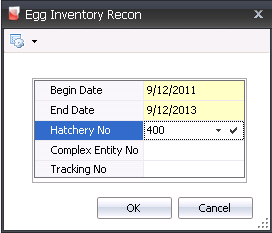
- In the Egg Inventory Recon dialog box, in
the Begin Date field, enter
the first date of the setter inventory to be viewed.
- In the End Date
field, enter the last date of inventory to be viewed.
- Optionally, the hatchery, complex entity
number and tracking number can also be selected in order to better
filter transactions. If required, from Hatchery
No, select the required hatchery.
- From Complex
Entity No, select the required entity, if applicable.
- Optionally, the
Tracking No can also be selected.
- Click 'OK', and all existing reconciliations
for the selected criteria will appear.

Record Type
indicates the source of the inventory detail. Available options are:
Received, Usage or Physical.
- Trans Code
determines the transaction type for the reconciliation record detail.
- Inventory Date
represents the date that the inventory was received or removed from
inventory. If the Inventory Time Mode registry switch is set to 'Date
Time', the record will be date and time stamped.
- Hatchery No
identifies the hatchery where the poults were hatched.
- Hatchery Name
displays the name of the hatchery.
- Complex Entity
No indicates the entity that produced the eggs.
- Farm Name
displays the name of the farm that produced the eggs.
Product No
defines the product utilized for the transaction.
- Product Name
displays a description of the product.
Tracking No
displays a unique reference number used to identify the group of eggs
in the transaction.
Prod Date
displays the date that the eggs were produced, to determine egg age.
Set Date
displays the date the eggs were set to hatch.
Buggy No
indicates the buggy on which the eggs were placed, if applicable.
- Buggy Name
displays a description of the buggy, if applicable.
- Setter No
identifies the setter in which the eggs were set.
Setter Name
displays a description of the setter.
Quantity
displays the number of set eggs utilized for the transaction.
Breed No
is used to identify the breed of the eggs.
- Breed Name
displays a description of the breed.
- Trans Quantity
displays the number of eggs in the transaction.
- Source Trans
Code indicates the type of source transaction.
Source Date displays the date the
original transaction occurred.

Source Quantity
displays the original amount of eggs that were received or purchased.
Source Remaining
Quantity displays the amount of inventory remaining from the
original transaction.
Transfer Date
displays the date that the eggs were transferred from the setter to
the hatcher.
- Hatcher No
indicates the hatcher in which the eggs were set to hatch.
- Hatcher Name
displays a description of the hatcher.
- Source Room Egg
Trans Code indicates the type of Source-Room transaction.
- Source Room Date
displays the date of the transaction from the Source Room - Egg Trans
Code.
- Source Room Purchase
Ref No indicates the purchase order number reference number,
if the eggs were purchased.
- Source Room Complex
PO No indicates the purchase order number, if the eggs were
purchased.
- The Consignment
flag will be selected if the eggs were purchased using a Consignment
Purchase Order.
Additional Reconciliation Fields
The fields described above are the typical fields used to analyze the
inventory reconciliation data. The following fields are also available
depending on the type of transaction that is being reviewed.
|
|
|
|
|
|
|
|
|
|
|
- Source
Room Creation Date
|
- Source
Room External Company No/Name
|
- Source
Room External Cost Center No/Name
|
- Source
Room Division No/Name
|
|
|
|
|
|