Finished Feed Inventory Reconciliation


The Finished Feed Inventory Reconciliation provides the details for all of the transactions in a specified period to determine the valuation. All transactions that related to the product will be listed in the inventory reconciliation to determine the quantity and valuation of the product. The transactions will be valued based on FIFO or Average Cost as defined in the feed mill registry.


The reconciliation can be run for a specified date range, feed mill and product. Once the data is generated, the screen can be filtered and grouped as required to view more specific data.
 

Generate Finish Feed Inventory Reconciliation

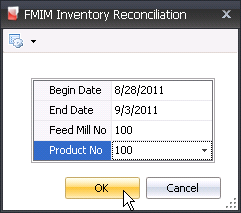
  1. In FMTS>FMIM>Inventory Reconciliation, select Finished Feed.
  2. Enter the required date range. The period is usually a global post period, but can be defined for any date range.
  3. Optionally, the Feed Mill No can be entered to filter the reconciliation data for a specified mill.
  4. The Product No can be selected if the reconciliation data is being generated for a specified product.
  5. Click OK.


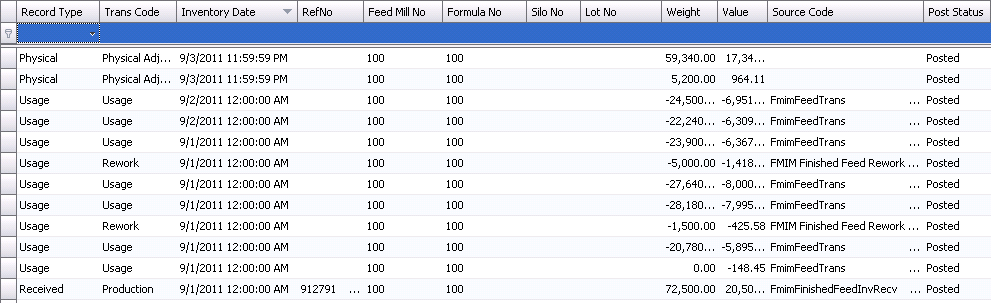
  6. The Inventory Reconciliation data will load based on the selected criteria


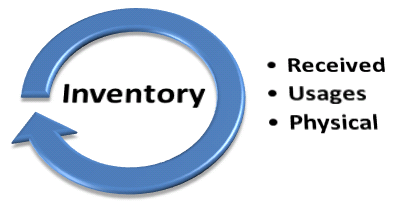
  7. Record Type indicates the source of the inventory detail. Options will be one of Received, Usage or Physical.
  8. Trans Code determines the transaction type for the inventory record detail.


    Record Type Trans Code
    Received
    • Beginning Inventory
    • Haulback
    • Production
    • Purchase
    • Receiving
    • Repack - Credit
    • Repack - Debit
    • Return
    • Rework Receiving
    • Silo Transfer - Credit
    • Silo Transfer - Debit
    • Transfer In
    • Transfer Out
    • Zero Quantity Adjustment - Credit
    • Zero Quantity Adjustment - Credit
    Usage
    • Disposal
    • Sale
    • Usage
    Physical
    • Physical Adjustment


  9. Inventory Date represents the date that the inventory was received or removed from inventory. If the Inventory Time Mode registry switch is set to 'Date Time', the record will be date and time stamped.
  10. Feed Mill No indicates the feed mill where the transaction occurred.
  11. Formula No identifies the formula within the system.
  12. Ref No represents the reference number for the transaction.
  13. Silo No is optionally used and references the silo where t he product is stored for the transaction. Cost will be maintained within the silo.
  14. Lot No is optionally used and references the lot number  stored for the transaction. Cost will be maintained within the lot.
  15. Weight is the weight of the feed formula used in the transaction. Weight is displayed in kgs or lbs depending on the unit of measure used by the feed mill.
  16. The Value represents the value from the thread that is used to value the transaction.

  17. Post Status identifies the record as being posted, active or reversed by global post. All records should be in posted status.

  18. Source Code  Identifies the origin of the transaction.

Additional Reconciliation Fields

The fields described above are the typical fields used to analyze the inventory reconciliation data. The following fields are also available depending on the type of transaction that is being reviewed.


  • Bag Unit Value
  • IRN
  • Thread Record Type
  • Transfer Destination Storage Mode
  • Bagged Unit Per
  • Product Type
  • Thread Ref No
  • Transfer Source Bag Unit Value
  • Bags
  • Reason Code Name
  • Thread Source Code
  • Transfer Source Bagged Units Per
  • Begin Date
  • Reason Code No
  • Thread Trans Code
  • Transfer Source Bags
  • Beginning Bag Unit Value
  • Remaining Bag Unit Value
  • Thread Unit Value
  • Transfer Source Feed Mill Name
  • Beginning Bags
  • Remaining Bags
  • Thread Weight
  • Transfer Source Feed Mill No
  • Beginning Unit Value
  • Remaining Unit Value
  • Trans Bag Unit Value
  • Transfer Source Formula Name
  • Beginning Value
  • Remaining Value
  • Trans Bags
  • Transfer Source Formula No
  • Beginning Weight
  • Remaining Weight
  • Trans Unit Value
  • Transfer Source Lot No
  • Creation Date
  • Rework Destination Ingredient Name
  • Trans Weight
  • Transfer Source Ref No
  • Delivery Creation Date
  • Rework Destination Ingredient No
  • Transfer Destination Bag Unit Value
  • Transfer Source Silo Name
  • Delivery Date
  • Rework Destination Lot No
  • Transfer Destination Bagged Units per
  • Transfer Source Silo No
  • Delivery Ref No
  • Rework Destination Silo Name
  • Transfer Destination Bags
  • Transfer Source Storage Mode
  • Expiration Date
  • Rework Destination Silo No
  • Transfer Destination Feed Mill Name
  • Unit Value
  • Feed Mill Name
  • Silo Name
  • Transfer Destination Feed  Mill No


  • Formula Name
  • Storage Mode
  • Transfer Destination Formula Name


  • Haulback Creation Date
  • Thread Bag Unit Value
  • Transfer Destination Formula No


  • Haulback Date
  • Thread Bags
  • Transfer Destination Lot No


  • Haulback Ref No
  • Thread Creation Date
  • Transfer Destination Ref No


  • Inactive Date
  • Thread Date
  • Transfer Silo No